


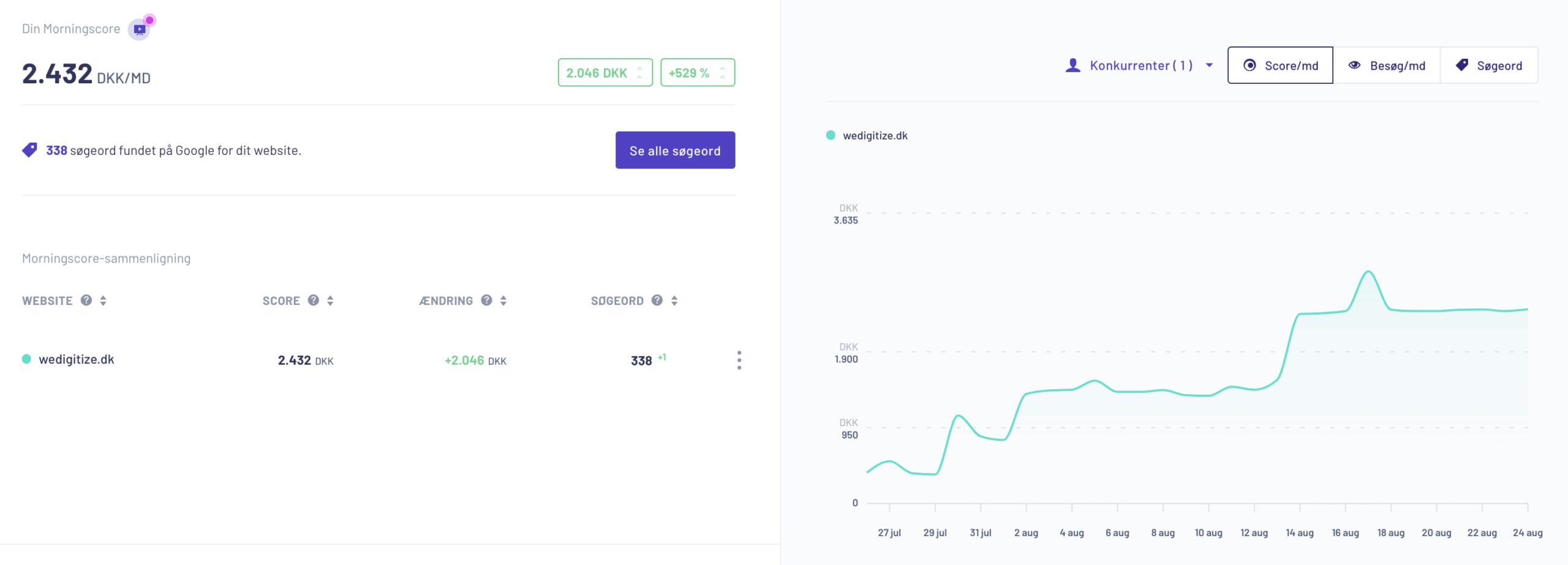
Morningscore Review: Danish SEO tool with AI, Missions, and Page Booster
Morningscore is a Danish SEO tool that helps you with keywords, competitor analysis, technical issues, links, AI visibility, and actionable SEO tasks in one place.
We tested Morningscore on a Windows 11 PC in Chrome and mainly used it on a WordPress site, where SEO work can quickly drown in tabs with Google Search Console, Rank Math, Ahrefs, spreadsheets, and scattered notes. What makes Morningscore stand out is that SEO is made more manageable and almost game-like: You get missions, points, and a clear idea of what to do next.
With Morningscore 4.3, the tool has taken a step forward. It’s no longer just about finding issues and opportunities. Now Morningscore also tries to help you do the work faster via AI, especially with the new Page Booster and the updated Rank Writer 2.0. Morningscore describes Page Booster as a feature that can analyze and optimize existing pages in platforms like WordPress and Shopify, while Rank Writer 2.0 has a new, more powerful engine for SEO content.
What is Morningscore?
Morningscore is a cloud-based SEO platform, so you don’t install a classic Windows or Mac app. You use it directly in your browser, so it works on Windows, macOS, Linux, and Chromebooks.
You can use it for things like:
- Keyword research
- Rank tracking in Google
- Competitor analysis
- Technical SEO checks
- Link analysis
- SEO missions with actionable tasks
- Reporting
- AI-assisted content work
- WordPress and Shopify integrations
One of the most appealing parts is that Morningscore doesn’t feel as heavy as Ahrefs or Semrush. It’s still a serious SEO tool, but it’s packaged so smaller businesses, store owners, bloggers, and marketers without deep technical SEO experience can jump in.
Morningscore 4.3: Page Booster is the big new feature
The most important addition in Morningscore 4.3 is Page Booster. It’s built for existing pages such as landing pages, category pages, product pages, and blog posts. Instead of only telling you a page can be improved, Page Booster analyzes it and suggests concrete changes.
This is especially interesting for WordPress and Shopify users because Morningscore now leans more into integrations where changes can be pushed closer to the CMS. Morningscore notes that its WordPress and Shopify plugins can scan issues, suggest fixes, and help push updates.
In practice, Page Booster is useful if you have many older articles, product pages, or categories collecting dust. It’s exactly the kind of work many site owners put off because it’s boring: updating meta titles, rewriting sections, improving search intent alignment, adding relevant subtopics, and making the page fit what the user actually wants.
Our take: Page Booster is most valuable as an assistant—not an autopilot. AI can quickly suggest improvements, but you should still review the text, especially if the page needs a personal tone, first-hand experience, or to match a specific editorial style.
Rank Writer 2.0 makes Morningscore more relevant for content
Morningscore already had an AI content tool, but with Rank Writer 2.0 it’s become far more compelling. According to Morningscore, the engine has been upgraded to explore topics more deeply and deliver more useful output than before.
That makes Morningscore particularly relevant if you work on lots of SEO articles, product pages, or guides. Rank Writer can help you build structure, find relevant angles, and write content that matches keywords and search intent.
Again, the best results come when you edit afterward. We wouldn’t publish AI text straight from the tool. But it’s great as a first draft—especially when you know the topic matters but aren’t sure where to start.
A Danish SEO tool focused on simplicity

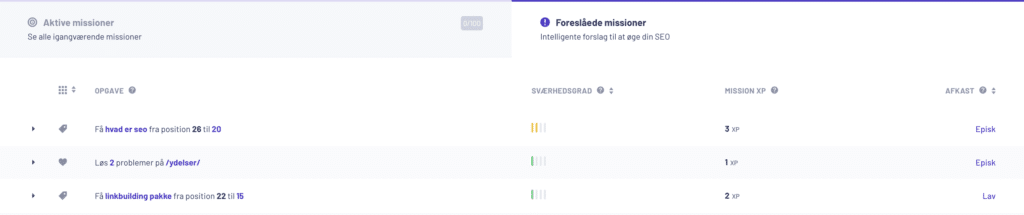
One of Morningscore’s biggest strengths is its interface. Many SEO tools are built for specialists, which is great if you do SEO all day. But for smaller teams, it can be too much.
Morningscore aims to make SEO more action-oriented. It does this with missions that give you specific tasks and an estimate of their impact on visibility. Instead of just a long list of issues, you get a more prioritized workflow.
It works well—especially if you’ve opened Google Search Console and thought, “Okay, but what do I do now?” Morningscore is at its best when it turns data into next steps.
Morningscore for WordPress and Shopify
Morningscore has become more interesting for WordPress and Shopify users after recent updates. According to Morningscore, its RANK AI plugin connects to WordPress and Shopify so the tool can scan issues, suggest fixes, and work closer to the CMS.
For WordPress users, it’s natural to compare Morningscore with Rank Math or Yoast SEO, but they don’t solve the same job. Rank Math primarily works inside WordPress with metadata, schema, redirects, and on-page SEO scoring. Morningscore looks wider at your overall SEO: keywords, competitors, links, technical tasks, missions, and visibility.
For Shopify store owners, Morningscore can be compelling because many shops have hundreds of product and category pages where small SEO improvements can make a big difference. That’s where Page Booster shines, since existing pages are often the lowest-hanging fruit.
AI visibility and SEO in Google and ChatGPT


Morningscore now talks not only about classic SEO, but also visibility in AI searches and GEO. That fits the trend where users don’t just find answers through traditional blue Google links, but also via AI overviews, ChatGPT-like searches, and answer engines.
That doesn’t mean classic SEO is dead. Far from it. Strong titles, high-quality pages, clear structure, relevant keywords, technical health, and trustworthy content remain the foundation. It’s a plus that Morningscore is starting to think beyond just Google rankings.
Morningscore vs Ahrefs, Semrush, Rank Math, and Google Search Console


Morningscore won’t necessarily replace Ahrefs or Semrush for heavy SEO specialists. Ahrefs is still stronger for deep link analysis, large keyword databases, and hardcore competitor research. Semrush is also very broad—especially for agencies and larger marketing teams.
However, Morningscore is often easier to get started with. It feels more like a tool that helps you prioritize work—not just show even more data.
In short:
- Morningscore is best for overview, SEO missions, an easy-to-use interface, and now AI-assisted optimization.
- Ahrefs is stronger for deep keyword and backlink analysis.
- Semrush excels for larger marketing teams and broad campaigns.
- Rank Math is best as a WordPress plugin for technical on-page SEO.
- Google Search Console is free and essential, but takes more experience to turn into action.
We wouldn’t choose Morningscore instead of Google Search Console—we’d use them together.
Who should use Morningscore?
Morningscore is a great fit for small and midsize businesses, online stores, marketing managers, freelancers, and site owners who want to work more systematically with SEO without drowning in complex reports.
It’s also a strong choice if you have many existing pages that need updates. Page Booster makes that process more manageable and can save a lot of time if you use it wisely.
Morningscore is less ideal if you only want a free tool, or if you already live in Ahrefs/Semrush every day and need maximum data depth. In that case, Morningscore can feel more simplified. But for many users, that simplification is exactly the point.
Security and practical use
Because Morningscore is an online SEO tool, think carefully about the integrations you connect. If you link it with WordPress, Shopify, or Google Search Console, make sure only relevant users on your account have access.
It doesn’t require installation on your computer, so there are no classic setup issues, toolbars, or unwanted extras. Use the official website and avoid third-party downloads pretending to be desktop versions.
Top 5 tips for Morningscore
Top 5 tips for Morningscore
Here are the five things we’d start with to get more out of Morningscore—without drowning in SEO data.
🎯 Use Missions as your weekly SEO to‑do
🚀 Use Page Booster on older pages with potential
🔎 Connect Google Search Console from day one
✍️ Treat Rank Writer 2.0 as a draft—not an autopilot
🤖 Optimize for Google, AI answers, and real people
A solid Danish SEO tool that has become more ambitious
Morningscore has long been one of the most user-friendly SEO tools on the market. With Morningscore 4.3, it’s more ambitious because it doesn’t just show what’s wrong—it also helps you fix it.
Page Booster is the standout addition, especially for WordPress and Shopify sites with lots of existing pages. At the same time, Rank Writer 2.0 makes Morningscore more relevant for serious content work.
It’s not a perfect tool. Experienced SEO specialists will still miss some of the depth in Ahrefs and Semrush. But for most businesses, online stores, and site owners, Morningscore is one of the most approachable places to start—and with the new AI features, it’s more relevant than ever.