 Martin Jørgensen
Absolute Memory – Digital matching game for the whole family
Absolute Memory is a simple yet classic take on the familiar memory matching game where you uncover pairs among hidden cards. It’s suitable for both kids and adults and a fun way to train your memory—right on your PC.
How to play Absolute Memory
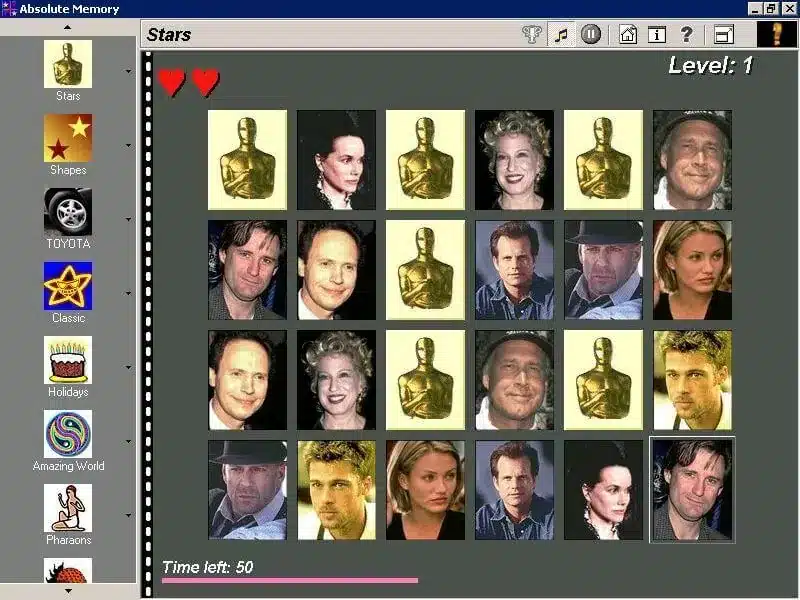
The premise is straightforward: a grid of face-down cards appears on the screen. You get two flips per turn to reveal cards and find matching pairs. Each correct match is removed from the board, and the goal is to find them all before time runs out.
The difficulty ramps up gradually with more cards and less time, keeping the challenge intact—even for adults.
Graphics and sound
Absolute Memory doesn’t aim for cutting-edge graphics, but uses clean, easy-to-read card icons that make motifs simple to tell apart. The audio is minimal but perfectly adequate for the gameplay.
Why choose a digital matching game?
There are plenty of matching games on mobile and in the browser, but Absolute Memory works without an internet connection and can be played offline. That makes it ideal as a children’s game for trips or in classroom settings.
Benefits of playing matching games on PC
The game can have a learning benefit—especially for kids—by strengthening focus and working memory. As a family activity, it also works well by taking turns against the clock to see who clears the board fastest.
Top 5 tips for Absolute Memory
Use a system
Always start from the top-left corner and work through the grid methodically. This helps your memory place the motifs and reduces confusion. A fixed sequence strengthens your ability to recall where you’ve seen specific cards—especially on larger boards.
Make it a competition
Time each other and take turns—it makes the game more exciting for both kids and adults. For example, keep a scoreboard with best times and fewest mistakes, or play “best of 3” for extra fun. It’s motivating for kids and adds an extra layer to the experience.
Repeat tough levels
If you don’t beat a level, replay it while focusing on patterns. Try remembering specific colors or shapes, and see if you can predict where the next pairs are. Repetition makes you better and faster—especially on levels with many cards.
Use the game as brain training
Use the game for daily practice if you want to improve short-term memory—especially helpful for older adults. Ten minutes a day is a fun, effective way to keep your brain active and can easily fit into a daily routine.
Play without stress
Even though there’s a timer, try playing without focusing on time at first. It improves learning for kids and creates a safe space where mistakes aren’t punished. Once the basics are solid, gradually introduce time pressure to increase the challenge.