
 Martin Jørgensen
Children of the Nile brings Ancient Egypt to life
Immortal Cities: Children of the Nile is a historical city-building game where you, as Pharaoh, must create a thriving civilization in Ancient Egypt with housing, farms, temples, trade routes, and monuments.
It may sound like classic city building in the same family as Pharaoh and Caesar, but Children of the Nile feels different once you get going. In our testing on a Windows 11 PC, we especially noticed how alive the city feels: citizens aren’t just numbers in a spreadsheet, but families and individuals with routines, needs, and roles in society.
Success here isn’t just about placing buildings efficiently. You need to build prestige, secure food, create jobs, keep priests and scribes working, and slowly shape a city that truly feels like a living society.
A city builder focused on people
The most compelling part of Children of the Nile is that citizens behave more individually than in many other strategy games. A farmer has a daily rhythm, the scribes have their functions, and the upper classes demand status, access to services, and proper surroundings.
That gives the game a slower, more organic pace. You’re not constantly chasing the next building. Instead, you observe the city, see where the chain breaks, and try to understand why certain citizens aren’t getting their needs met.
This is where Children of the Nile still shines. The interface may feel dated, but the core idea of a living population holds up surprisingly well.
Prestige, temples and monuments
As Pharaoh, you don’t just build to survive. You build to be remembered. Prestige is central, and you gain it through grand monuments, religious buildings, well-functioning city planning, and contact with the world beyond your borders.
Pyramids, temples, and palaces aren’t just decoration. They’re part of the game’s power structure and status. The better your city runs, the easier it is to gather the resources and labor needed for major projects.
That makes Children of the Nile more patient than many modern strategy games. Rewards don’t come instantly, but when your city finally clicks, it’s deeply satisfying.
How Children of the Nile feels today
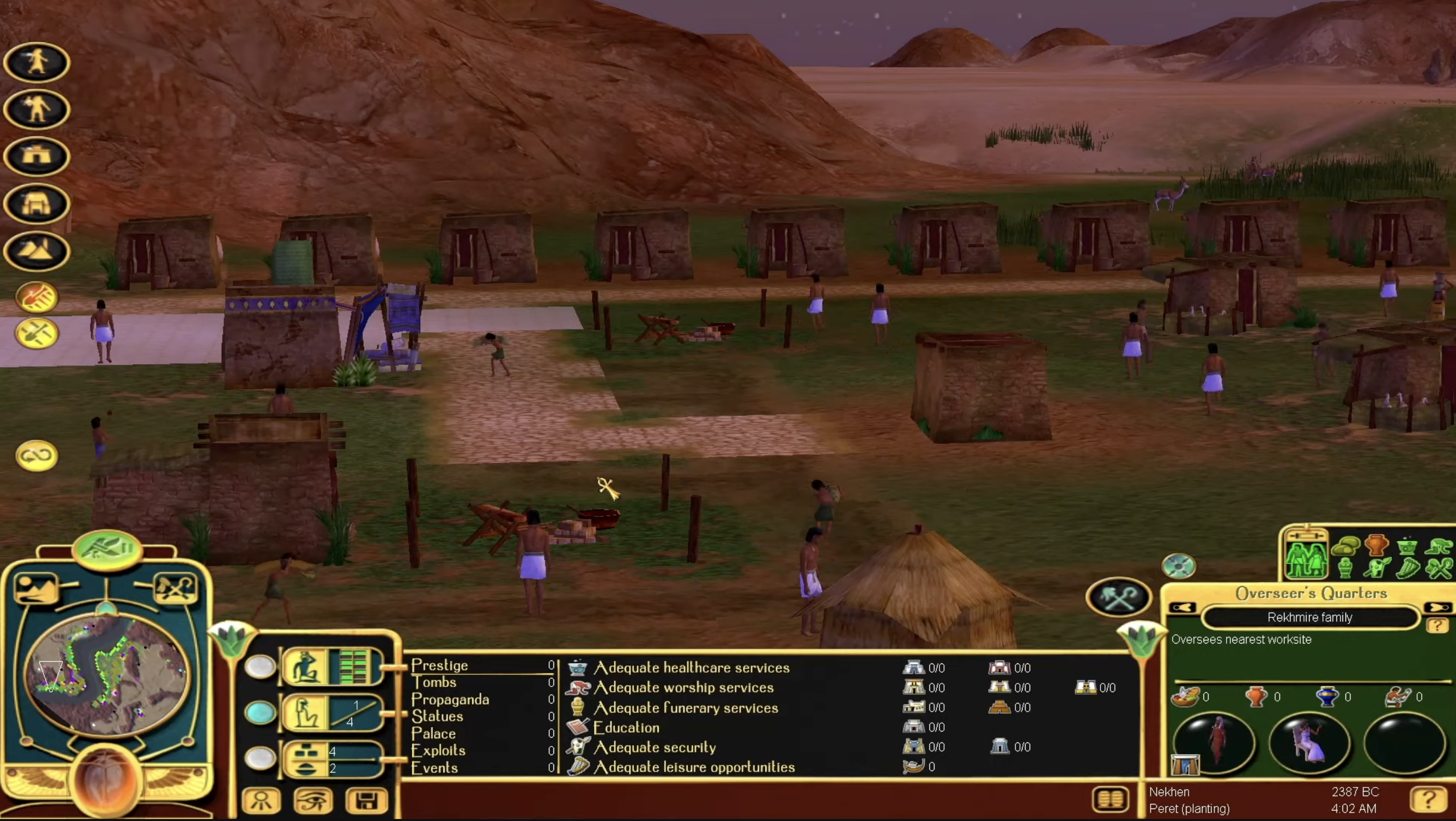
Visually, you can tell the game has some years behind it. Characters, animations, and the interface don’t have the sharpness of newer city builders, and the tempo takes some adjustment. On the other hand, the warm, unmistakably Egyptian atmosphere still does a lot for the experience.
We found the game especially rewarding for players who enjoy tinkering with systems rather than building quickly. It’s not a game where you can place buildings at random and expect everything to work. If priests lack food, if the elite don’t get the right goods, or if logistics stumble, the entire city feels it.
That can be frustrating at first, but also very satisfying once you begin to understand the game’s logic.
Top 5 tips for Children of the Nile
Start small and build at a steady pace
Children of the Nile often punishes expanding too fast. Secure food, housing, and core services before you dive into large prestige projects.
Keep an eye on family needs
Your citizens are the engine of the city. Follow individual people around when something breaks. It often reveals whether the issue is food, distance, or missing services.
Don’t build monuments too early
Pyramids and temples matter, but they require a stable society behind them. Wait until the economy and workforce can support the project, or the rest of the city may stall.
Distances matter more than you think
Place key services so citizens don’t waste time walking. A beautiful city isn’t necessarily an efficient one.
Play it like a simulation, not a race
The best experience comes from observing the city and tuning as you go. Children of the Nile is slower than many modern strategy games—and that’s its charm.