 Martin Jørgensen
The SEO landscape is undergoing its biggest shift in years. Where the battle once focused solely on Google rankings, visibility is now also won—or lost—inside AI-generated answers from tools like ChatGPT, Gemini, and Copilot. That’s the context for Morningscore 4.
Morningscore 4 isn’t just a new version with a fresh design. It’s a clear signal that SEO tools are starting to operate in two parallel worlds: classic SEO and what’s now called GEO—Generative Engine Optimization. In this article, we look at what that means in practice and why Morningscore 4 matters in a broader SEO perspective.
What is GEO—and why is it becoming more important?
GEO stands for Generative Engine Optimization and focuses on optimizing for AI models that generate answers instead of simply showing links. When users ask questions in AI tools, they don’t see a traditional search results page—they get a synthesized answer built from many sources.
That fundamentally changes how visibility is created. Ranking for a keyword isn’t enough anymore. Content must be clearly structured, easy to understand, and positioned as authoritative before AI models will choose to use it.
Many in the industry say GEO is just good SEO. That’s partly true. Classic SEO work like technical health, strong content, and clear authority still plays a decisive role. But GEO also raises new questions:
- Is my brand mentioned in AI-generated answers?
- Which topics is my website associated with?
- Is my content easy for AI to cite and summarize?
These are exactly the questions Morningscore 4 tries to answer in concrete ways.
Two environments—one unified approach to visibility
One of the most striking changes in Morningscore 4 is the split into two environments. Classic SEO work lives in a light interface, while the GEO tools sit in a dark interface.
The split makes it clear when you’re handling traditional SEO tasks like keywords, links, and on-page optimization—and when the focus is on visibility inside AI models. For many users, that separation creates clarity and calm, treating GEO as its own discipline instead of mixing it into existing SEO workflows.
SEO Score and data quality as the foundation
Morningscore has long used score-based measurements as a core part of the platform. In version 4, the keyword engine has been significantly upgraded with better data quality and more precise assessments.
SEO Score still works as an overall benchmark, but now it’s backed by stronger data that makes prioritization easier. That’s especially important at a time when both SEO and GEO demand strategic choices rather than blanket optimization.
Google Search Console integration as the bridge
The new Google Search Console integration makes it possible to automatically import keywords based on real impressions and clicks. That means your work in Morningscore is grounded more in actual performance data, not just estimates.
In a GEO context, that’s interesting because content with proven visibility is often the same content AI models prefer to use. GSC data can act as an indicator of which pages have the greatest potential in both SEO and GEO.
GEO Score and measuring AI visibility

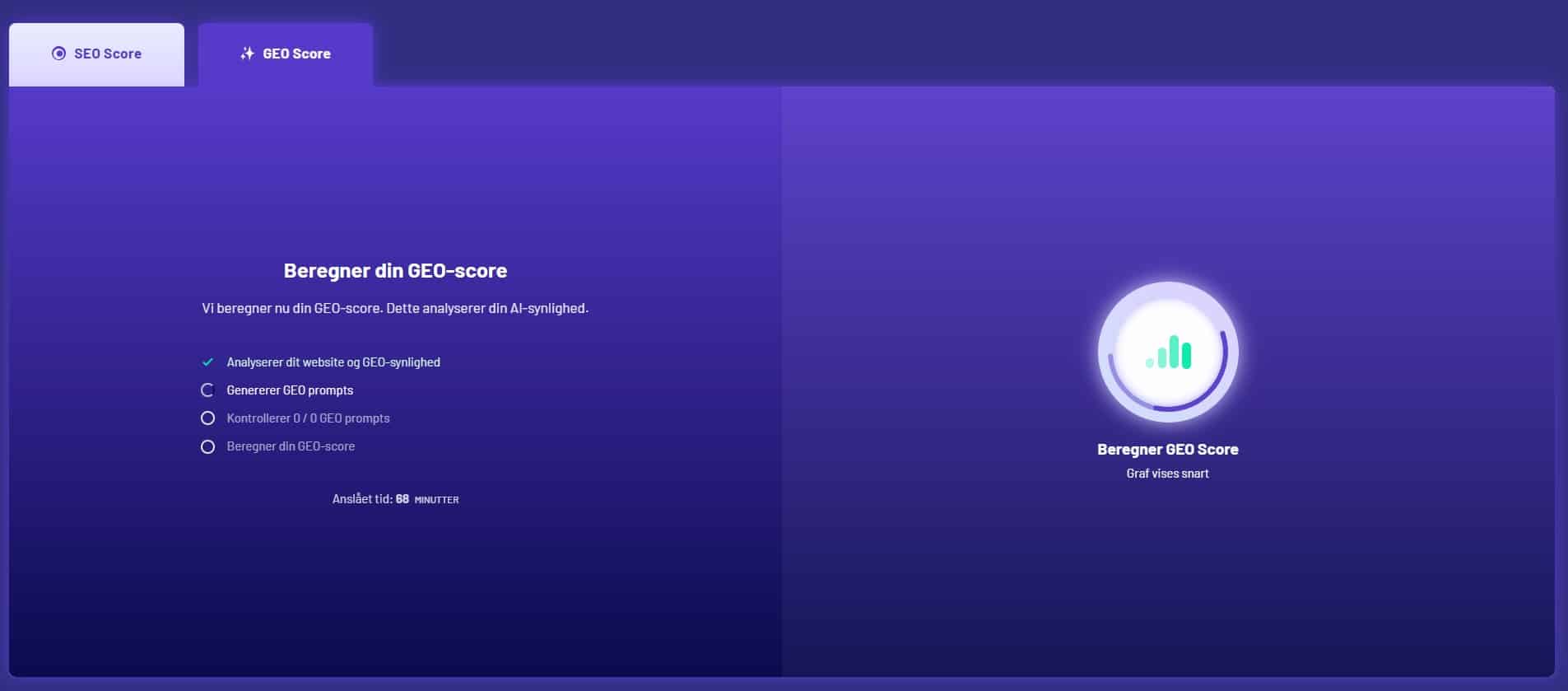
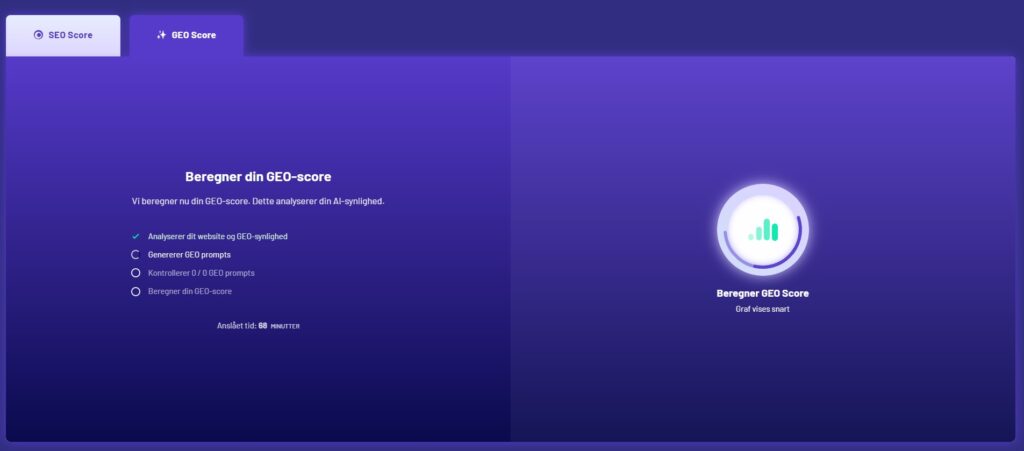
GEO Score is one of the most eye-catching additions in Morningscore 4. It aims to give you an overview of how a website appears in AI-generated answers.
The score is based partly on generated prompts related to your website and analyses of how AI models respond. It isn’t an exact science, but it’s a concrete first attempt to quantify a discipline that can otherwise be hard to approach systematically.
For many, GEO Score works best as a compass rather than a KPI—a place to start the conversation about how AI interprets and uses your content.
Automation and AI content in practice
Morningscore 4 introduces a new Automations section where both SEO and GEO tasks can be automated. You’ll find tools like RANK AI content writer, which can generate copy based on a single keyword combined with a page’s context.
Automation can save time and add structure, but the biggest value appears when these tools act as support rather than replacement. AI can help with ideas, drafts, and scale, but quality and relevance still require human judgment.
GEO analysis and AI benchmarking
The new GEO analysis tool lets you generate AI benchmarking reports for any website. That enables comparisons of how different brands and pages appear in AI answers across industries.
For agencies and larger teams, it can become a valuable tool in client conversations where AI visibility is otherwise hard to make tangible.
CMS integrations and workflows
With both a Shopify app and a WordPress plugin, Morningscore moves closer to day-to-day content work. Especially the integration between Rank Writer and WordPress—where articles can be created directly as posts—highlights the focus on an efficient workflow.
It points to a shift where SEO and GEO aren’t just about analysis, but about making execution and implementation easier.
Who gets the most value from Morningscore 4?
Morningscore 4 is especially relevant for:
- Small and midsize businesses that want a structured approach to both SEO and GEO
- Marketing teams that combine strategy with hands-on execution
- Agencies that want a simple way to introduce clients to AI visibility
A clear signal of where SEO is heading
Morningscore 4 shows how SEO tools are adapting to a reality where visibility is no longer created only in Google’s search results. GEO is still in its early phase, but the need to understand and work with AI visibility will only grow.
By combining SEO and GEO in one tool—without blurring the differences—Morningscore offers a concrete take on how the future of online visibility can be structured and prioritized.