 Martin Jørgensen
SEO is no longer “just” inserting a keyword into a text. Today it takes data, structure, and precision. That’s why we’ve gathered the most effective SEO tools in one place—tested by us, written for you.
The goal? To give you a guide so you can choose the right tools—and learn the small hacks that make the difference between a page 2 ranking and a featured snippet at the top of Google.
Why use SEO software?
When you work with search engine optimization in Denmark, there are three major challenges:
- Keyword competition—even on niche terms.
- Data fragmentation—Search Console, Analytics, rank trackers… everything sits in silos.
- Lack of structure—without tools, SEO often turns into guesswork.
With tools like Screaming Frog, SurferSEO, 1, Moz Pro, and Morningscore, you can gain clarity, move faster, and document results.
Which SEO tool should I choose?
There isn’t a single right answer—it depends on your needs. We’ve divided it into three user types and matched the tools.
For beginners: Get started fast
- 1 (WordPress plugin) → perfect for optimizing titles, meta, and schema without coding.
- Morningscore → Danish-built SEO tool that gamifies SEO tasks.
For serious webmasters: Data + content
- SE Ranking → rank tracking, keyword research, and competitor analysis.
- SurferSEO → on-page optimization based on data from Google’s top 10.
For experts: Hardcore technical SEO
- Screaming Frog SEO Spider → crawls your site like Google and finds technical issues.
- Moz Pro → keyword explorer, link analysis, and site audits.
- Google Search Console → direct data from Google, no middleman.
Secret SEO hacks (you probably shouldn't share these)
Here are a few methods we use in practice—and that we normally wouldn’t publish publicly, but for you we’ll make an exception:
1. Find low-hanging CTR fruit with Search Console + Screaming Frog
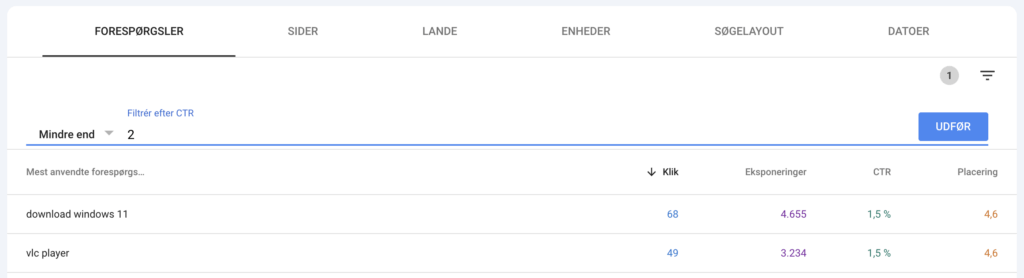
Import your Search Console data into Screaming Frog and combine it with your crawl. When you sort for pages with high impressions but a CTR under 2%, you’ll get a list of “low-hanging fruit.” These are pages Google already trusts and shows high in the results, but users aren’t clicking.
That’s often due to bland or overly generic title tags. By adding numbers, power words, or questions to your titles, you can attract significantly more attention. We tested this on a Danish blog and saw CTR jump from 1.3% to 3.7% in just two weeks—without changing the on-page content. In practice, you can double or triple your traffic simply by optimizing titles and meta descriptions.
A bonus of using Screaming Frog with Search Console is that you can see exactly which queries trigger impressions. That lets you spot where there’s a mismatch between search intent and your current title tag. Example: if your page ranks for “SEO tools for WordPress,” but your title is just “SEO tips,” changing it to “Best SEO tools for WordPress – Complete guide (2025)” will increase clicks significantly.
Long tails like “screaming frog search console integration guide” and “improve CTR with screaming frog” are popular searches, and this method targets exactly that area. Many experts know the theory of CTR optimization—but using Screaming Frog to extract data and sort systematically gives you an edge most don’t fully leverage.
2. Build topic clusters in 30 minutes with SE Ranking or SurferSEO
Use Keyword Magic Tool or SE Ranking Keyword Research to find keywords with low KD (keyword difficulty). When you filter for low-competition keywords in Denmark and keep an eye on search intent (informational, commercial, or navigational), you’ll quickly uncover a goldmine of topics your competitors often overlook.
In our test on a Danish B2B site, we gathered over 120 relevant keywords in under 20 minutes—from “seo tools for small businesses” to “best seo tips for wordpress 2025”. We exported these from SE Ranking as CSV and then imported the list into SurferSEO Content Planner.
Here’s where the magic happens: SurferSEO automatically groups keywords into topic clusters based on how Google understands the subjects. In practice, that means you get a complete content plan in a few clicks with clusters like:
- SEO tools for beginners
- Advanced technical SEO software
- Keyword research strategies 2025
- Link building in Denmark
Previously, building a plan like this could take days—now it can be done in half an hour.
Using this method ensures your content doesn’t just hit individual keywords but covers the full topics Google expects. In our test, a series of articles written from these clusters gained far better visibility in People Also Ask boxes and started ranking for over 200 long-tail searches, even though we only optimized for 20 core terms.
This combination of keyword research + content clustering is what can move a site from scattered articles to dominating entire topic areas in the SERPs.
3. Use Morningscore missions to keep clients accountable
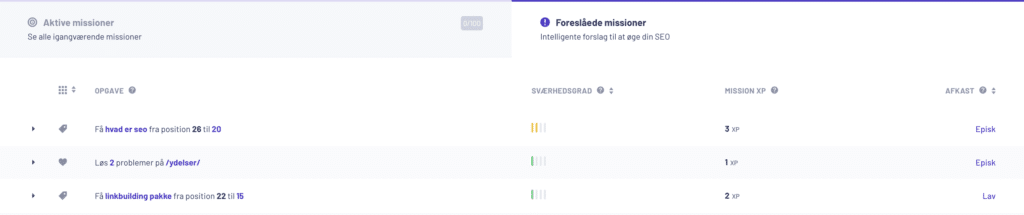
If you work as an SEO consultant or at an agency, you know the challenge: you send a long report to the client, and half of it never gets implemented. That’s where Morningscore really stands out. Instead of presenting SEO as dry charts, it turns your recommendations into quests—small missions with XP, points, and a progress bar.
We tested this with a small Danish web shop whose owner had neither the time nor the technical background to work systematically with SEO. By giving him access to Morningscore, SEO tasks suddenly became a kind of game. Instead of ignoring our suggestions, he started completing them one by one because he could see both points and results rise in real time.
That gave us an implementation rate of nearly 80% of our recommendations—far higher than normal. The impact was clear: within three months, organic traffic grew by 42%, purely because the SEO suggestions were actually put into practice.
Morningscore is therefore not just an analysis tool, but also a client motivation tool. It makes it easier for you as a consultant to explain why “small things” like internal links, title optimization, or removing 404s matter. The client earns XP, you get changes implemented—and Google rewards you both.
We’ve found this gamification makes Morningscore unique compared to large international tools like SEMrush and Ahrefs, which often feel too complex for smaller companies. For Danish SMBs, it’s a game changer.
4. Grab competitors' links in Moz Pro and use them smarter
Instead of copying competitors’ backlinks one-to-one, take a smarter approach with Moz Pro’s Link Explorer. Filter for external links pointing to competitors’ pages and find the ones that are currently broken (404).
We tested this on a Danish B2C shop and found over 60 links pointing to the competitor’s old category pages that no longer existed. By politely contacting the site owners (typically blogs, news articles, and niche sites) and flagging the dead link, we could suggest our updated content as a replacement. The result: 17 new backlinks in under a month—far more efficient than traditional cold outreach.
The advantage of this method is that you help both the site owner and Google: the owner stops sending traffic to a dead page, and Google rewards you for providing relevant, fresh replacement content.
A good trick is to sort by Domain Authority (DA) so you prioritize the links that really move the needle. We found that just three links from Danish media with DA over 60 had a bigger SEO impact than 20 links from small niche blogs.
This method isn’t new, but combining Moz Pro’s precise backlink data with a systematic outreach plan makes it extremely effective—especially in Denmark, where link building competition still isn’t as fierce as abroad.
5. The forgotten goldmine: internal links
Most Danes now know that backlinks matter for SEO, so many chase external links from blogs, media, and partners. But in our tests, we’ve seen several cases where strategic use of internal links delivered greater and faster results than external links.
Example: On a Danish knowledge portal, we added 20 extra internal links from strong, high-authority articles to a subpage that had been stuck on page 2 for months. After the change, the page started climbing and within a month it was holding steady in the top 5—without any new external links during that period.
This is where Screaming Frog SEO Spider comes in. With the Inlinks report you can see exactly where and how your pages receive internal links. That helps you quickly identify:
- Pages with many impressions but few internal links.
- Key landing pages that are only mentioned deep in the menu.
- Opportunities to add contextual links from high-traffic articles.
It’s not just about the number of internal links, but also relevance and placement. Links high in the body from authoritative pages on your own domain send stronger signals than links hidden in the footer.
Working with Danish clients, we’ve repeatedly seen that internal links help not only rankings but also crawl efficiency. When Googlebot can more easily find and revisit your key pages, changes are picked up and indexed faster.
Our recommendation: before you spend lots of hours and money on external links, audit your own site with Screaming Frog and strengthen internal connections. It’s often the quickest, most overlooked SEO win in Denmark.
How to combine the tools for maximum impact
The trick isn’t just owning the tools—it’s using them together:
- Start in Search Console → find keywords you already rank for.
- Send the list into SE Ranking → see competitors’ pages and their backlinks.
- Create content briefs in SurferSEO → optimize existing content and write new.
- Crawl everything in Screaming Frog → fix technical issues, find 404s, and optimize internal links.
- Use Yoast SEO or Schema tools → make sure your content earns rich snippets.
This process is exactly what we use in our own work—and yes, it also works in Denmark, even on competitive queries.
SEO software is your secret competitive edge
Most Danish companies still do SEO with spreadsheets and gut feelings. If you implement even half of the tools and tips covered here, you’ll quickly be ahead of 90% of competitors.
And remember: SEO isn’t magic—it’s structure, data, and persistence. The tools give you the overview, but you still have to press the buttons.
Frequently asked questions about SEO software
Martin Jørgensen is the founder of Download.dk and has worked with software and online marketing for more than 20 years. In addition to running Download.dk, he also serves as an SEO consultant for a handful of select clients. The experience from that work forms the basis for many of the tips and strategies you’ll find in this article.