
 Martin Jørgensen
Mystery Case Files: Ravenhearst – Experience gothic suspense and forgotten secrets
Mystery Case Files: Ravenhearst is an atmospheric hidden-object game where you step into the role of a master detective to unravel the secrets behind the grim and enigmatic Ravenhearst Manor. With a story full of secret rooms, diary pages, and ghostly ambience, this game became one of the most popular titles in the Mystery Case Files series.
The game is developed by Big Fish Games and can still be purchased and played on modern Windows PCs via their platform.
Top 5 tips for Mystery Case Files: Ravenhearst
Start with the diary pages
Find and collect the diary pages as early as possible—they're the key to the story and help you understand what's happening in each room.
Track patterns and symbols
Many later puzzles require you to remember specific symbols or sequences. Jot them down as you go or take screenshots.
Use hints wisely
You have a limited number of hints, and they recharge slowly—use them only when you're truly stuck.
Don't click blindly
Too many wrong clicks trigger a temporary penalty where the screen shakes and you lose time. Click carefully and with precision.
Use sound and music as clues
Ambient sounds like footsteps, creaks, or eerie music can lead you to hidden rooms or key items. Use headphones for maximum effect.
Story and gameplay in Mystery Case Files: Ravenhearst
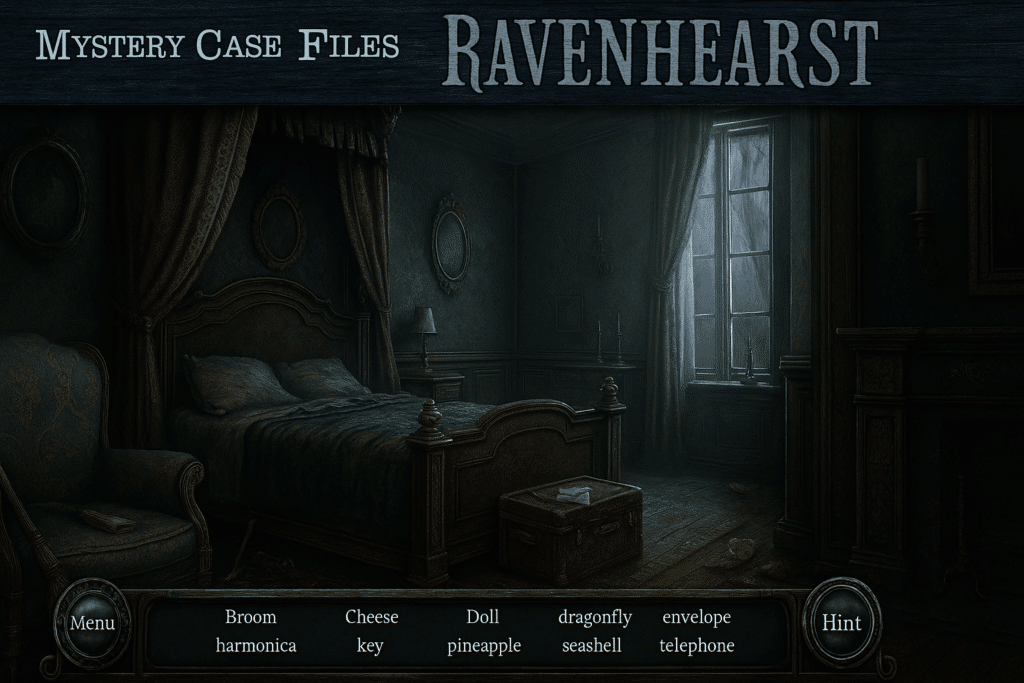
The game takes place in a Victorian manor in England, where, as a detective, you're tasked with investigating the mystery surrounding Emma Ravenhearst's disappearance. Using her missing diary pages, you must uncover what really happened behind those dark walls.
The gameplay blends classic hidden-object mechanics with puzzle mini-games and a strong narrative drive. You'll explore 32 different rooms and locations throughout the manor, searching for hidden objects and solving puzzles to get closer to the truth.
Graphics and sound
The game uses detailed backdrops and a gothic, dark style that fits the mystery perfectly. Every room in Ravenhearst Manor is packed with small visual details—from dusty bookcases and creaking floorboards to flickering candles and hidden panels—giving you the feeling of truly being present in the old manor. The art direction favors atmosphere over pixel-perfect realism, which suits the game's narrative focus.
The music and sound effects build a tense, intense atmosphere, where each piano note or distant breath adds to the feeling that something is lurking just beneath the surface. It's especially effective in quiet moments when environmental sounds take over—like rain against the window, an unexpected knock, or the creak of a door moving on its own.
While it's not graphically advanced by today's standards, it still delivers a solid, atmospheric experience. In fact, the slightly older visuals can enhance the sense of mystery and classic chills—like opening a forgotten book from another era. The game proves you don't need 3D rendering or ray tracing to create an engaging and eerie mood—it comes down to creativity, sound, and visual balance.
Why it still holds up today
Although the game originally released in the mid-2000s, it's still highly playable and popular among fans of puzzle and detective games. It's one of the titles that helped lay the foundation for the hidden-object genre and continues to inspire new entries in the series.